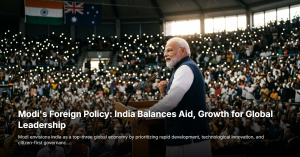





India’s geopolitical and economic importance continues to grow as it balances relationships with major powers like the United States, Russia, and China. Politically, India seeks to assert its global influence while maintaining strategic autonomy. Economically, the country is positioning itself as a key manufacturing hub and a reliable alternative to China in global supply chains.
India has strengthened ties with the US through defense agreements, technology cooperation, and participation in forums like the Quad, which also includes Japan and Australia. These actions are part of India’s efforts to ensure strategic security in the Indo-Pacific region. At the same time, India maintains long-standing defense and energy relationships with Russia, a legacy of past alliances that still serves its interests today.
With China, India manages a complex relationship marked by border tensions and competition over regional influence. Recent years have seen military standoffs along the disputed Himalayan border, pushing India to deepen partnerships with like-minded democracies. Nonetheless, economic ties with China remain significant, making the relationship both competitive and cooperative.
Domestically, India focuses on economic reforms, infrastructure growth, and digital innovation to support its global ambitions. It aims to attract foreign investment and promote a self-reliant economy under initiatives like “Make in India” and “Digital India.” Its growing population and expanding consumer market also make it a strategic destination for international business.
As India walks the fine line between great power interests while securing its own growth, it is emerging as an influential player in shaping the future geopolitical and economic landscape of the world.